
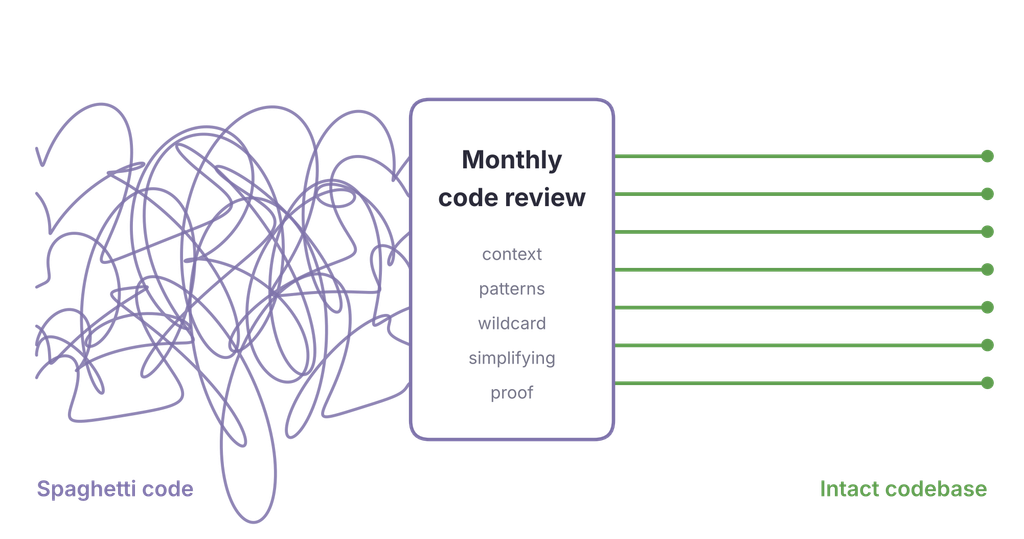
Jede neue Funktion, jeder Fix, jede KI-Änderung legt Code drauf. Ohne Kontrolle wird daraus Spaghetti. Und irgendwann bricht etwas, das niemand mehr versteht. Bei einer gevibecodeten App passiert das schneller, weil der Code schneller wächst, als ihn jemand liest.
TL;DR: Ohne regelmäßigen Code Review wird jede gevibecodete App zu Spaghetti. Ein monatlicher KI-Review mit vollem Kontext, eigenen Bug-Mustern, Zufallsszenarien und Simplifying hält die Codebase intakt.
Kurz & knapp
- 1 Hauptthema: Wie ein monatlicher, automatischer KI-Code-Review eine komplexe, gevibecodete App intakt hält.
- 2 Wichtige Punkte:
- 2.1 Erst der Kontext (Architektur, Doku, alte Bugs), dann jede Datei.
- 2.2 Vier Blöcke: Patterns, Common Mistakes & Security, Wildcard, Simplifying.
- 2.3 Jeder Fund wird simuliert und von unabhängigen Prüfern bestätigt.
- 3 Fazit: Nichts wird automatisch angewendet. Der Review ist der Teil, der die Codebase intakt hält.
Keine Spielzeug-App
Hourcast ist ein Micro-SaaS für YouTube-Kampagnen in Google Ads: Backend, Datenbank, WordPress-App, Google-Ads-Script, Stripe, E-Mails. Komplett gevibecodet. Ein Feld heißt im Script anders als im Backend, ein Webhook kommt zweimal, und der Fehler zeigt sich Wochen später beim Kunden.
Entwickler haben dafür feste Prozesse: Code Reviews, Tests, Security-Checks. Vibecoder meist nicht. Dabei lässt sich genau dieser Prozess heute mit KI-Agenten selbst vibecoden.
Ein Scheduled Task, der stundenlang läuft

Jeden 1. des Monats, allein, oft mehrere Stunden. Keine Stichprobe, keine übersprungene Datei. Und er darf nichts ändern: nur lesen, testen, berichten. Ein Kill Switch kappt vorher jede Verbindung zur Produktion.
Erst der Kontext laden. Architektur, System Flow, Changelogs, Doku, die echte Datenbankstruktur und jeder je gefixte Bug. Ohne Kontext findet eine KI Fehler, die keine sind. Mit Kontext weiß sie, was der Code tun soll.
Dann der Code Review.
Die vier Prüfblöcke
Der Review hat ein Budget an Tokens, also an Rechenzeit. Jeder Block bekommt einen festen Grundanteil davon:
| Block | Grundanteil | Was er prüft |
|---|---|---|
| Patterns aus eigenen Bugs | 35 % | Jeder gefixte Bug wird zum Suchmuster. Derselbe Fehler wird an neuen Stellen gejagt. |
| Common Mistakes & Security | 40 % | Leere Werte, Zeitzonen, Währungen, Login, Zugriffsrechte, Webhooks. |
| Wildcard | 15 % | Würfel statt Checkliste: ein Trial-Kunde in Japan, 00:05 Uhr, Stripe meldet sich zweimal. Dazu eine Zufallsrolle, etwa „Buchhalter, der jeden Cent prüft“. |
| Simplifying | 10 % (fix) | Toter Code, Duplikate, KI-Slop. Nur Änderungen, die nachweislich nichts am Verhalten ändern, geprüft mit 500+ Zufallseingaben. |
Vor jedem Durchlauf werden diese Anteile neu ausgewürfelt. Jeder Block bekommt bis zu 10 Prozentpunkte mehr oder weniger, aber nie unter 5 %. Ein Monat geht fast die Hälfte in Patterns, der nächste ein Viertel in die Wildcard.
Der Grund: Ein Review verliebt sich sonst in seine eigenen Funde. Wo er letztes Mal etwas gefunden hat, schaut er wieder hin. Und wieder. Immer tiefer in dieselbe Richtung. Alles andere bleibt ungeprüft, nur weil dort bisher niemand gesucht hat. Ein klassischer Survivorship Bias. Die Wild Card bricht diese Schleife.

Nur Simplifying bleibt fix bei 10 %. Spaghetti-Code bricht nicht sofort. Er macht jede Änderung teurer, bis keine mehr geht. Darum wird jeden Monat aufgeräumt, egal was der Würfel sagt.
Der Review führt den Code auch aus
Lesen allein reicht nicht. Der Review startet den Code in einer abgeschotteten Kopie und spielt echte Abläufe mit Fake-Daten durch:
- Ein Tag im Leben: Fake-Kunden in Österreich, Kalifornien und Japan, von der Bezahlung bis zum Trial-Ende. Inklusive Zeitumstellung.
- 60 Tage im Zeitraffer: Fließt das Geld zu den besseren Kampagnen, oder schwingen die Budgets?
- Test the Tests: Fünf alte Bugs werden zurück in eine Kopie gebaut. Die Tests müssen alle finden.
Kein Fund ohne Beweis
Das größte Problem von KI-Reviews sind False Positives. Darum braucht jeder Fund ein Code-Zitat und eine Simulation. Dann versuchen zwei unabhängige Prüfer-Agenten, ihn zu widerlegen, bei kritischen Fällen drei. Ein „Nein“, und er fliegt raus. Eine zweite Runde sucht, was die erste übersehen hat.
Nichts wird automatisch angewendet
Am Ende: ein Report in einfachem Englisch. Jeder Fall als kurze Geschichte mit echtem Beispiel, dem exakten Fix und wie man ihn prüft. Oben die drei wichtigsten Fixes mit Zeitschätzung.
Jeder Fall wird gelesen und verstanden, erst dann geht der Fix live. Wer die Fixes nicht versteht, versteht seine App bald nicht mehr.
Ohne Review keine intakte Codebase
Ein automatischer Code Review ist kein Extra. Er hält eine gevibecodete App über Monate intakt: lesbarer Code, geprüfte Datenflüsse, Lücken gefunden, bevor es jemand anderes tut.
Der Code Review-Prompt
Zum Nachbauen:
# Monthly automated code review — <PRODUCT>
Scheduled task, 1st of every month. Unattended. Read-only.

You are a senior software engineer, security reviewer and systems
architect reviewing <PRODUCT>: <one sentence what it does>.
Stack: <backend>, <database>, <frontend>, <external scripts / APIs>.

Nobody is watching this run. Work autonomously from start to finish.
Completeness and correctness matter more than speed. This run may take
hours. Do not stop early, do not sample, do not skip files.
Use as many tokens as the review needs.

## 0. Hard rules
1. READ-ONLY. Never change, push, deploy or delete anything in any
   repo, server, website, database, doc or setting. The only output
   is the report. Live checks are GET requests only.
2. SECRETS. Never print, log or write any token or secret, not even
   partially.
3. NO FALSE POSITIVES. A finding is reported only if it is proven
   with quoted code and a reproduction, and survives independent
   checkers (section 6). If it cannot be proven, it is not reported.
4. UNATTENDED. Never ask questions. If a choice is unclear, take the
   most conservative option and list it under "Decisions for me"
   with options A / B and a recommendation.
5. LANGUAGE. Plain, simple English. I am not a professional
   programmer and not a native speaker.

## 1. Setup
1. Clone all repos (read-only token) with full history.
2. Hotspot map: per file, number of commits and number of fix
   commits. The top 10 files get extra depth.
3. Recent-changes map: every commit of the last 30 days, with the
   functions and routes it touched. New code is read twice.
4. Load the real database schema (schema-only export, no customer
   data) into a local Postgres. Check every SQL statement against it.
5. Random effort split (use a real random source, never choose):
   - Base shares: Patterns 35, General 20, Security 20, Wildcard 15.
   - Shift each by a random integer -10…+10, minimum 5, rescale to 90.
   - Simplifying is fixed at 10. Total = 100.
   - Do NOT look at previous runs. Each run starts fresh.
   - Pick one random deep-focus area of the codebase.

## 2. Safety before running any code
- Network kill switch: block every outbound connection before any
  repo code runs. Prove it first: three test requests must fail.
  If the proof fails, review statically only.
- Fake credentials only. Install dependencies without install scripts.

## 3. Tools and test harnesses (leads, never findings)
- Static tools: secret scan over the full git history, semgrep with
  local rules, linters, dependency audit, dead-code and duplicate
  detection, a complexity map (longest and deepest functions).
- Harnesses: call the core logic with fixtures and property-based
  tests (fresh random seed per run); mount the API against the local
  DB and send bad auth, broken bodies, duplicate requests; sign fake
  webhooks; run external scripts with mocked APIs; a differential
  harness that compares old vs. simplified code on 500+ random inputs.
- Test the tests: put 5 random old, already-fixed bugs back into a
  scratch copy. Every harness must catch all 5. If not, improve the
  harness before the review starts.

## 4. Context first, code second
Read before reviewing: architecture, system flow, docs, the newest
changelogs, the security doc, and ALL bug registers. Turn every past
bug into a pattern card: what it looks like, 1–2 real examples, how
to search for it, how to prove it. Note every "do not re-raise" item.
Where docs and code disagree, report it as drift, without a verdict.

## 5. Review — one agent per area, in parallel
Split the codebase into areas. Every file belongs to exactly one area.
Every reviewer reads every assigned file in full and returns its line
count as proof. Work in this run's effort split:
- A. PATTERNS: run every pattern card on every file. Hunt old bugs
  in new places. The area's top 5 patterns first and deepest.
- B. GENERAL: empty / null / zero / huge values, unicode, time
  zones, currencies, error handling, silent failures, race
  conditions, the same action running twice.
- C. SECURITY: auth, authorization, injection, XSS / CSRF, webhook
  signatures, rate limits, exposed files, unsafe defaults.
- D. WILDCARD: 20 random scenarios per area. Roll one ingredient from
  3 of these lists: who (trial customer, attacker, cancelled
  customer…), when (00:05, 29 February, time change…), what breaks
  (server restart, payment provider down, timeout…), odd data (zero
  spend, emoji, other currency…), timing (two tabs, double submit…).
  Plus one random role, e.g. "tired operator at 2 a.m.", "a
  competitor trying to hurt us", "an accountant checking every cent".
  Simulate every scenario with the harnesses. Never just imagine it.
- E. SIMPLIFYING (always 10 %): dead code, duplicates, long or deeply
  nested functions, AI slop, stale comments. Only changes with ZERO
  difference in behaviour. Max ~60 lines per case.

Special agents (every run): interfaces between all systems, one day
in the life of fake customers in 3 time zones, 60 days in fast motion
(3 random seeds, check invariants every day), every place that
writes critical state, reachable dependency vulnerabilities, old
fixes still present, live GET checks of the public sites.

Rounds: after round 1, a NEW reviewer per area gets only the list of
findings so far and must find what round 1 missed. Up to 3 rounds.
Stop when a round finds nothing new.

## 6. Verification — triple check
1. Reviewer proof: quoted code (file:line) + reproduction.
2. Checker A: a new agent tries to DISPROVE it and re-runs the repro.
3. Checker B: a second new agent, independent of A, does the same.
4. High / Critical: a third new checker C.
One "rejected" = dropped. Simplifications: both checkers try to find
any input where the new code behaves differently.
Every fix is proven in a scratch copy. Then ALL fixes are applied
together and every test runs again.

## 7. Report
One markdown file. Plain English, short sentences, no jargon.
- TL;DR in one line. "Do these first": the 3 most important fixes
  with a time estimate each.
- One case per finding: what happens as a story with a real example
  (which customer, which time, which amount, what they see), why it
  matters, evidence, exact find / replace, how to verify after deploy.
- Tables: interfaces, simulations, dependencies, regressions, live
  checks, docs/code drift, decisions for me, coverage of every file.
- Nothing is applied automatically. I read and understand every case
  before anything goes live.

## 8. Finish
Delete all clones, harnesses and the local database. Send a short
push notification: TL;DR, findings per severity.